

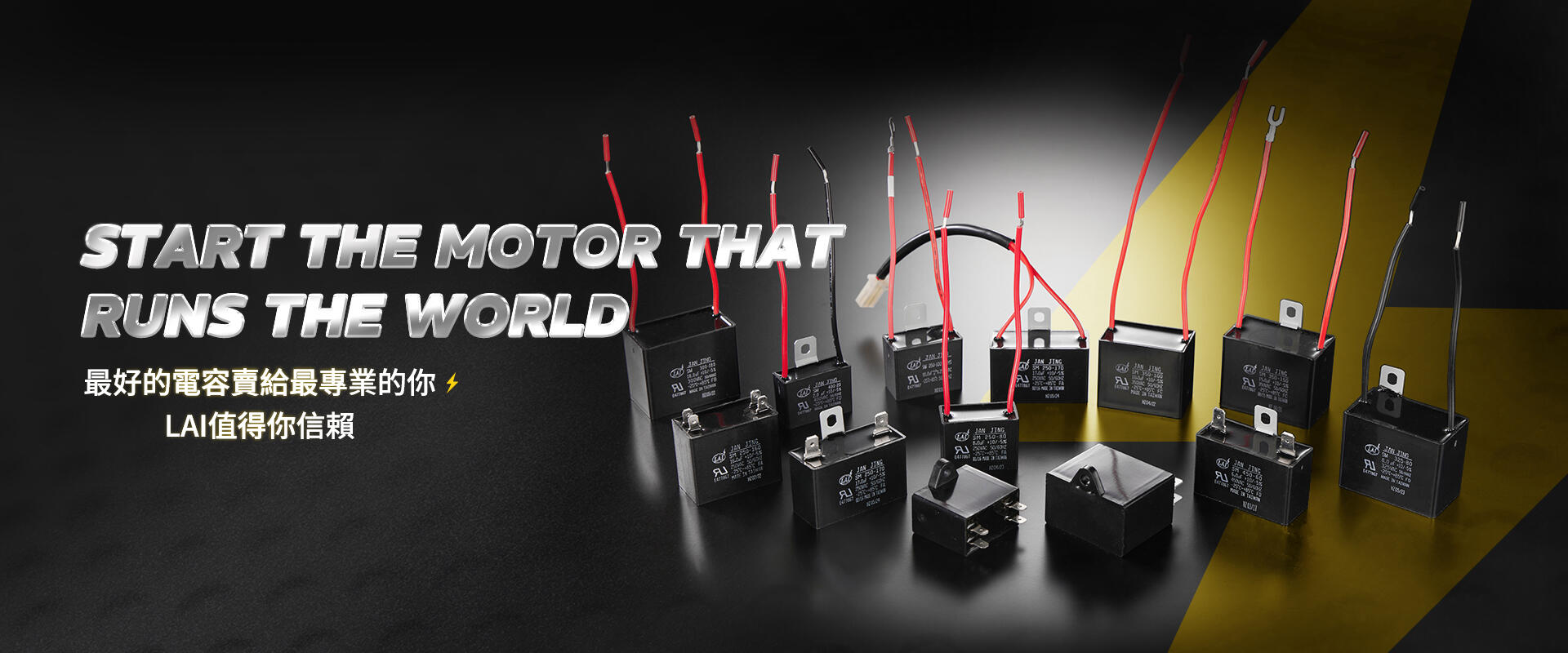
What's the Difference Between Start and Run Capacitors? Specifications, Voltage, and Working Principles Explained

What Are Start and Run Capacitors, and What's the Difference?
Simply put, both start capacitors and run capacitors are vital components that assist in the operation of single-phase motors. Below are the detailed specifications of these capacitors.
What Are Their Primary Purposes?
Start Capacitor: Mainly responsible for the "initial startup." At the exact moment the motor starts, it provides a starting torque that is 3 to 5 times greater than that of normal operation, helping the motor start up quickly.
Run Capacitor: Mainly responsible for "long-term stable operation." It maintains continuous operation after the motor has started, thereby stabilizing the current and magnetic field to ensure smooth and long-lasting operation.
Duration of Operation
Start Capacitor: Operates for an extremely short period, connecting to the circuit only at the exact moment of motor startup.
Run Capacitor: Operates long-term and continuously, from the moment the motor starts until it shuts down. It requires higher heat resistance and stability.
Capacitance Size
Start Capacitor: Features a larger capacitance, aiming to provide sufficient energy instantaneously at startup. The common range is between approximately 100μF and 800μF.
Run Capacitor: Features a smaller capacitance, with the primary function of stabilizing operation and improving the power factor. The common range is between approximately 1μF and 100μF.
Differences in Durable Design
Start Capacitor: Used only for short periods. Its design emphasizes high instantaneous output capability, mostly utilizing an electrolytic design, which is large in size but cannot be continuously energized long-term.
Run Capacitor: Needs to work continuously for long periods. Its design emphasizes high-temperature resistance and long-term voltage stability, typically using non-polar metallized film capacitors with high durability.
What Are the Scenarios of Incorrect Capacitor Selection?
In real-world applications, many equipment malfunctions do not stem from the motor itself, but are frequently caused by the incorrect selection of capacitors.
1. Master the Specifications and Avoid Interchanging Them
Interchanging the two is a common and quite dangerous mistake in equipment maintenance. If the differences between a start capacitor and a run capacitor are not clearly understood, it can easily lead to equipment abnormalities or even damage.
Using a "Start Capacitor" as a "Run Capacitor" easily leads to: capacitor bulging, overheating, burning out, fluid leakage resulting in functional failure, unstable motor operation, and equipment downtime/malfunction.
Replacing a "Start Capacitor" with a "Run Capacitor" results in: the motor failing to start, insufficient starting torque, prolonged startup time, abnormal current rise, and motor overheating.
2. Ignoring Voltage Specifications and Only Looking at Capacitance
If you only verify whether the μF capacitance value is identical without paying attention to the voltage rating (VAC), a lack of sufficient voltage tolerance will accelerate capacitor aging over long periods of use, and may even cause bursting or damage.
3. Failing to Confirm the Actual Operating Environment and Duty Cycles
To avoid shortening the service life of a capacitor, it is vital to first understand the environment and requirements of the installation site—such as high-temperature or high-humidity locations, or conditions requiring continuous long-term operation—in order to select the most appropriate capacitor.
4. Insufficient Voltage Selection Leading to Failure
If the rated voltage of the capacitor is not chosen high enough—for example, selecting a 125VAC capacitor for a 220V circuit system—it will result in insufficient starting torque, causing short circuits, fires, or explosions. Operating a capacitor long-term near its upper voltage limit can also easily lead to failure.
How to Correctly Select a Start or Run Capacitor?
Mastering capacitor specifications and using them correctly can significantly boost equipment efficiency and extend motor lifespan.
- Cross-Reference with Equipment Markings and Original Manufacturer Recommendations
The best practice for selecting the correct capacitor specifications is to cross-reference the marking details on the equipment with the manufacturer's technical manuals. This includes parameters such as capacitance (μF), rated voltage (VAC), frequency (Hz), working temperature, and application type (Start / Run), avoiding any arbitrary modifications.
- Choose Products That Comply with Capacitor Specifications and Safety Certifications
In industrial environments or applications requiring long-term continuous operation, high-quality capacitors must be selected stringently. Look for features such as: explosion-proof safety designs, international safety certifications (e.g., UL, VDE, CE), stable thermal performance, and a long service life design.
High-Quality Capacitor Specifications Recommendation: Lai Enterprise
Lai Enterprise is an AC capacitor manufacturer established for over 35 years, accumulating more than 20 years of hands-on experience. The AC capacitors we produce have gained widespread industry recognition in the Taiwan market. Offering a comprehensive range of high-quality capacitor products long-term, including start capacitors and run capacitors, our products meet stringent safety certifications and stable quality demands. We can provide tailored options based on different equipment conditions, making us your most trusted partner.
If you have any doubts regarding capacitor selection, welcome to contact us. We are ready to provide you with the most precise technical support.